
Hunting Tsessebe in South Africa: The Complete Hunter’s Guide
Tsessebe can be easy to overlook when you are putting together a South African plains-game list. Kudu, sable, gemsbok, wildebeest, and eland tend to get more attention. Spend some time hunting Tsessebe, though, and you quickly understand why experienced African hunters value a good mature bull.
At our 55,000-acre Wildschutsberg Game Farm in the Eastern Cape, Tsessebe can form part of a wider plains-game safari for bow hunters or rifle. We have been hunting here since 2000, and our professional hunters and trackers know the animals, the terrain, and how conditions change through the season. Wildschutsberg is malaria-free and sits in the foothills of the Stormberg Mountains near Queenstown.
If hunting Tsessebe in South Africa is on your list, this guide covers what you should know before you arrive, from identification and behavior to trophy judging, hunting methods, bow-hunting considerations, timing, and preparing for the hunt.
Key takeaways for hunting Tsessebe
- The common Tsessebe hunted in South Africa is Damaliscus lunatus lunatus, also known as the sassaby.
- Both bulls and cows have horns. Mature bulls generally have a heavier build and thicker horns, but field judging still requires care.
- Older bulls may have worn horn tips, so apparent horn length on its own can be misleading.
- Tsessebe are predominantly grazers and favor productive grassland and relatively open habitat.
- They are social, vigilant animals, and their preference for open ground can make a close approach challenging.
- Tsessebe can be hunted with rifle or bow.
Skip ahead: I’d like to book a hunting safari | Show me hunting packages
What is a Tsessebe?
The common Tsessebe is a member of the Damaliscus group of African antelope, alongside animals such as the topi, korrigum, and tiang. Its scientific name is Damaliscus lunatus lunatus.
Historically, Tsessebe occurred across large areas of southern Africa. Within South Africa, their natural range included parts of Limpopo, Mpumalanga, North West, Northern Cape, Free State, and northern KwaZulu-Natal. They have also been introduced or reintroduced to suitable wildlife areas elsewhere in the country.
They are specialist grazers compared with many of the more adaptable antelope you may encounter on safari. Good-quality grass and appropriate habitat matter to them, and population performance can suffer where grazing quality declines or competition with other grazers becomes excessive. SANBI notes that suitable habitat and conservative stocking rates are important to successful Tsessebe populations. For a hunter, their preference for good grazing also gives you a clue as to where your PH is likely to start looking.
What does a Tsessebe look like?
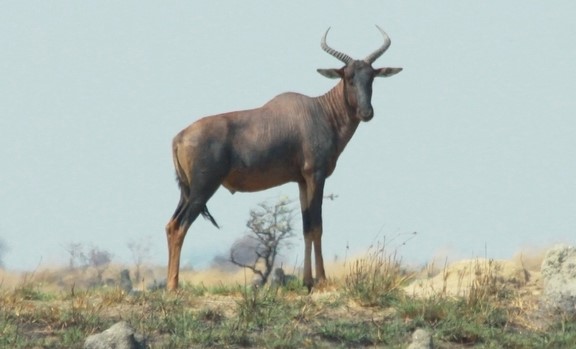
Once you have watched Tsessebe for a while, their silhouette becomes unmistakable.
- The shoulders sit noticeably higher than the rump, producing a sloping back.
- The muzzle is long and fairly narrow.
- Adults have a reddish to chestnut-brown body with darker markings over the face, shoulders, and upper legs.
- Mature bulls can appear considerably darker than younger animals, particularly around the head, neck, and shoulders.
- Both sexes grow ringed horns. The horns rise from the head, sweep outward, and curve upward, with smoother tips above the heavier annulated section.
That sloping build can give a standing Tsessebe an almost front-heavy appearance. It does not translate into poor movement. Tsessebe are built to cover open ground quickly, which is worth remembering if a herd becomes suspicious during a stalk.
Explore: 2026 guide to African hunting prices, packages, and trophy fees
Idea shot placement
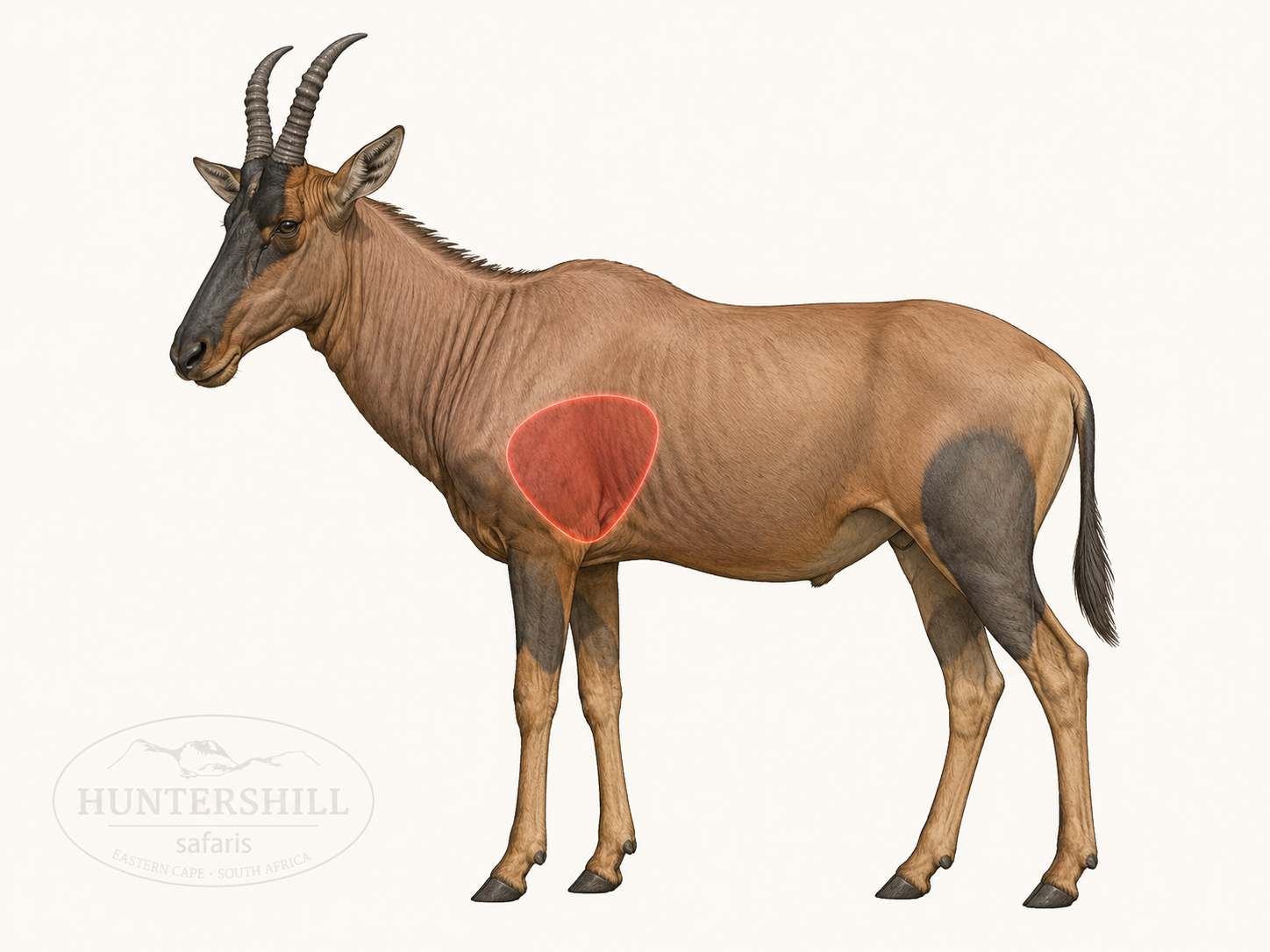
For a Tsessebe, the preferred shot is usually broadside or slightly quartering away, giving you a clear path into the heart and lungs. Aim just behind the front shoulder, roughly through the lower third of the chest, rather than too far back into the body. Tsessebe are tough, fast animals, so waiting for a calm, unobstructed presentation is worth it. Your PH will confirm the angle and exact point of aim before you shoot, especially if other animals are standing close to the bull.
Rifle hunting Tsessebe
Bring a plains-game rifle that you know and shoot well. Familiarity and consistent accuracy are more useful than arriving with a rifle that looks impressive on paper but is unfamiliar in your hands. Before travelling, spend time shooting from sticks. Practice acquiring the target cleanly, settling yourself, and making a controlled shot without spending several minutes getting comfortable. Also practice after walking. Your breathing and heart rate in the field will rarely resemble your breathing and heart rate while sitting at a range bench.
International travel with firearms involves additional preparation, so read our hunting in South Africa FAQs before you finalize your plans. Rifles are also available at the lodge if you prefer not to travel with your own firearm.
Bow hunting Tsessebe in South Africa
Tsessebe can make an excellent bow-hunting quarry for an experienced plains-game bow hunter. There are two challenges. First, you need to get close enough for a shot you can make confidently every time. Second, Tsessebe commonly occur with other animals, so patience around a herd is important.
Before you arrive, make sure your bow is properly tuned and practice from realistic hunting positions rather than relying only on ideal target-range conditions. Your personal maximum range should also be realistic. Africa is a poor place to discover that the distance you can occasionally shoot on a target is different from the distance at which you can consistently make a good hunting shot.
Tsessebe bull vs cow: How can you tell the difference?
This is one of the first things we discuss with hunters who have not hunted Tsessebe before. A cow has horns. So does a bull. At longer distances, the overall shape of the two can look remarkably similar.
| What to look at | Mature bull | Cow |
|---|---|---|
| Body | Usually heavier and more robust | Generally lighter |
| Neck and shoulders | Often heavier through the front end | Usually finer |
| Color | Mature bulls may appear darker | Often lighter |
| Horn bases | Typically thicker and heavier | Usually finer |
| Horn length | Generally longer, although wear matters | Generally shorter |
| Overall judgment | Several clues should be assessed together | Can resemble a younger bull at distance |
Horn wear makes things more interesting. Studies of Tsessebe aging have found that male horn length can decrease as bulls grow older because the tips are worn down, including through ground-horning behavior.
That is why we do not judge a Tsessebe by visible horn length alone. Your PH will look at the whole animal: horn mass, bases, wear, body size, maturity, color, behavior, and its position in the group. Give them time. Tsessebe are one of those species where a few extra minutes behind the binoculars can make a considerable difference.
What makes a good trophy Tsessebe?
For most trophy hunters, maturity comes first. A mature bull should show the heavier body and horn development associated with an older male. Heavy horn bases, good mass, shape, and overall maturity all form part of the assessment. Worn tips do not automatically make an older bull an inferior animal.
For hunters interested in record-book measurements, the current Rowland Ward minimum for Tsessebe or sassaby is 15 inches (38 cm). The current listed record is 18 7/8 inches (47.9 cm), measured under Rowland Ward Method 7-a.
We would still encourage you to look beyond a number while you are hunting. A mature old bull with character and obvious wear may make a far more meaningful trophy than an animal selected purely because somebody estimated its horns at a particular length.
If official record-book qualification matters to you, tell your PH before the hunt. That gives everyone the same objective when animals are being assessed.
For more general information about trophy species and how we approach trophy hunts, see our guide to trophy hunting in Africa.
Tsessebe behavior: What hunters should understand
Tsessebe are social antelope, so you will often be dealing with more than one pair of eyes. Groups may consist of females and young, bachelor males, or animals associated with a territorial bull. Mature males can be territorial and use various displays and scent-marking behaviors. Ground-horning is one of those behaviors and contributes to the wear that can become visible on older bulls.
From a hunting perspective, herd behavior is important. You may be concentrating on one mature bull while several other animals are looking in different directions. Movement that the bull misses may be picked up immediately by another member of the group.
Tsessebe also favor country where they can see. They prefer grasslands, floodplains, bushveld, and the transition between grassland and woodland, with a preference for less densely wooded areas and medium-height grass in studied populations.
That openness works both ways. You can sometimes locate animals from a good distance, but they may have an equally good opportunity to locate you.
When is the best time to hunt Tsessebe in South Africa?
Hunting conditions change significantly through an Eastern Cape season, so the best dates depend partly on how you want to hunt and what else is on your species list. Many international hunters favor hunting in the cooler and drier months because vegetation opens up, mornings are cool, and conditions are well suited to longer days in the field. Bow hunters can also benefit from the reduced vegetation and changing animal movement that come with drier conditions.
Plan a Tsessebe hunting safari with us
A Tsessebe hunt can be one of the highlights of a much bigger African experience. Long days in the Eastern Cape, time in the field with your PH and trackers, friends and family, hunters and non-hunters alike. Evenings back at the lodge, and the stories that stay with you long after the hunt is over.
Our hunting packages are designed to make the whole safari easy to enjoy, with accommodation, meals, drinks, laundry, your professional hunter, trackers and skinner, hunting vehicle, hunting license, and field preparation of your trophies taken care of. Bring the whole family. There’s something for everyone at Huntershill.
Enquire today, and we’ll build a safari around the kind of experience you want to take home with you.
FAQs
Can you hunt Tsessebe in South Africa?
Yes. Tsessebe can be hunted legally in South Africa subject to the applicable permits, hunting regulations, and availability. Tell us during the booking process if Tsessebe is a priority species so the hunt and paperwork can be planned correctly.
Is Tsessebe good trophy game?
Yes. Mature Tsessebe bulls are valued plains-game trophies, particularly because judging them requires experience and both sexes carry horns. Rowland Ward currently lists a 15-inch minimum for Tsessebe.
How can you tell a male Tsessebe from a female?
Mature bulls are generally heavier-bodied and have thicker, heavier horns. The differences can be subtle at distance, and older bulls may have worn horn tips, so your PH should make the final call.
How big is a trophy Tsessebe?
Rowland Ward’s current minimum is 15 inches, or 38 cm, with a listed record of 18 7/8 inches, or 47.9 cm. Trophy quality should also be judged on maturity, horn mass, shape, and the overall animal.
Can you bow hunt Tsessebe?
Yes. We offer bow hunting for Tsessebe, subject to availability and the normal planning requirements. Our published bow-hunting guidance recommends 65 ft-lb of kinetic energy and a 450-grain arrow for Tsessebe.
What should I practice before a Tsessebe hunt?
Rifle hunters should spend plenty of time shooting from sticks and getting comfortable taking controlled shots from realistic field positions. Bow hunters should know their reliable hunting range and practice from the positions they expect to use in Africa.
What do Tsessebe eat?
Tsessebe are predominantly grazers and favor good-quality grass. SANBI notes that they can obtain enough moisture from growing grass to go for extended periods without drinking under some conditions.
What habitat do Tsessebe prefer?
They are primarily associated with grassland, floodplain, bushveld, and relatively open grassland-woodland habitats. Studies in South Africa have found preferences for less densely wooded areas with medium-height grass.
How much does it cost to hunt Tsessebe in South Africa?
Trophy fees and availability can change, so use our current 2026 pricing rather than an older price list found online. See our 2026 hunting cost guide and current packages, or contact us for the current Tsessebe fee.
Is Tsessebe suitable for a first African hunt?
Yes, provided you arrive comfortable with your rifle or bow. Be sure to listen to your PH. The field judging gives experienced hunters something to think about as well, so Tsessebe works equally well as an addition to a first plains-game safari or a return trip.