
Père David’s Deer Hunting in South Africa
Across Huntershill Safaris’ 55,000 acres, mountains fall away into open grassland and wide valleys. Somewhere in that landscape is a deer that looks as though it has borrowed features from several different animals: the mysterious, other-wordly Père David’s deer.
A mature Père David’s deer stag has a heavy body, long face, thick neck, broad hooves, and a dark-tufted tail. Above its head sits a set of antlers unlike those carried by any other deer at Huntershill. The main beams rise upward while the long tines sweep backward, giving the trophy an instantly recognizable shape.
Also known as the milu, Père David’s deer is native to China. It disappeared from the wild in its original range and survived because a small population was protected and bred outside the country. Today, Huntershill is home to Père David’s deer as part of its diverse wildlife population of more than 70 species. For visiting hunters, this creates a very exciting opportunity to pursue an uncommon deer species while experiencing a full African hunting safari in South Africa’s Eastern Cape.
Key takeaways
-
Père David’s deer is a large, heavy-bodied deer originally from China.
-
The species is also known as the milu or “four unlikes.”
-
Mature stags carry tall antlers with distinctive backward-facing tines.
-
Père David’s deer are social, alert, and closely associated with grassland and water.
-
The heart and lungs lie low in the chest behind the front shoulder.
-
You can hunt Père David’s deer at Huntershill in the Eastern Cape, South Africa.
-
Huntershill offers both rifle and bowhunting safaris in the Eastern Cape.
What is a Père David’s deer?
Père David’s deer, Elaphurus davidianus, is the only living member of its genus. It developed in the wetlands, floodplains, and river valleys of China, where its body became suited to soft ground and water. Its appearance gave rise to the Chinese name sibuxiang, meaning “four unlikes.” Traditional descriptions say it has the hooves of a cow, neck of a camel, antlers of a deer, and tail of a donkey. The comparison varies from one telling to another, but the meaning remains the same: this animal does not look quite like any other familiar deer.
The broad, spreading hooves support its weight on marshy ground. Père David’s deer are also strong swimmers and can spend long periods standing in water, particularly during warm weather. Their long tails, which end in a dark tuft, are unusual among deer species.
The coat changes through the year. It is generally reddish-brown or tan during warmer months, often with a dark stripe running along the back. The winter coat becomes thicker, shaggier, and more gray-brown. Mature males develop a heavier neck and mane around the throat.
The survival story behind the species
By the nineteenth century, Père David’s deer had disappeared from most of China. The last known herd was protected inside the Imperial Hunting Park near Beijing.
French missionary and naturalist Father Armand David saw the animals there in the 1860s. Specimens were later sent to Europe, where zoologists formally described and named the species. Flooding damaged the walls of the imperial park in 1895, allowing animals to escape. Hunting and political unrest then destroyed the remaining Chinese herd. By the beginning of the twentieth century, the species had become extinct in its native wild range.
A small number remained in European collections. Herbrand Russell, the 11th Duke of Bedford, brought the surviving animals together at Woburn Abbey in England and established a breeding herd. Every living Père David’s deer descended from that small surviving population. Animals were returned to China during the 1980s and placed in protected reserves. Several managed populations have since been established, including free-ranging herds in suitable parts of the country.
At Huntershill, we support wildlife that has become rare or disappeared from its native environment. We provide space for managed herds to breed and live in extensive natural surroundings. Regulated hunting forms part of this wildlife-management system, with mature animals selected according to the population and conditions on the property.
Habitat, feeding, and daily behavior
Père David’s deer are strongly associated with open grassland, rivers, wetlands, and marshy ground. Their diet consists mainly of grass, although they also eat leaves, shoots, and aquatic plants. They are social animals and are often encountered in herds. Females and younger deer commonly remain together, while mature stags may form separate groups or spend time alone outside the breeding season.
During the rut, mature stags become more active and aggressive. They scent-mark their surroundings, wallow in mud, and use vegetation to decorate their antlers. Rival males display and clash as they compete for access to females. A rutting stag may appear darker and heavier because of the mud and vegetation carried on its body and antlers.
How big is a Père David’s deer?
A full-grown Père David’s stag is a substantial animal. Mature males commonly weigh between 300 and 440 pounds, with some individuals growing heavier. They stand around four feet at the shoulder and carry much of their weight through a deep chest and powerful front end.
The head is long and narrow, while the eyes sit high on the skull. Large scent glands are visible below and in front of the eyes. The ears appear relatively small compared with the length of the face. A mature stag’s neck becomes thick where it joins the shoulders. Long hair around the throat and chest adds to this bulk, which can make the shoulder line difficult to read from certain angles. The position of the front leg gives a more reliable reference for the location of the chest and vital organs.
The size of the body also matters when selecting equipment. Père David’s deer have more body mass and heavier bone than many smaller African antelope. Rifle caliber, bullet construction, bow draw weight, arrow weight, and broadhead choice all need to provide sufficient penetration for a large deer.
What makes a good Père David’s deer trophy?
The antlers make a Père David’s stag immediately recognizable. The main beams rise above the head, while the principal tines point backward. This is the opposite of the forward-facing tine structure seen on many better-known deer species.
A mature trophy is judged through a combination of antler and body characteristics. The professional hunter looks at the length and mass of the beams, spread, tine development, overall shape, neck thickness, body depth, and the stag’s apparent age.
Symmetry contributes to a formal trophy measurement, but many older stags carry small differences between the left and right antler. Worn or uneven points can add age and character. A heavy, mature stag with thick beams and a distinctive antler shape often makes the stronger hunting trophy, even when another animal appears more even at first glance.
The antlers can be measured under recognized international trophy systems. Measurements generally consider beam length, circumference, spread, and individual antler development. The unusual shape works well as a shoulder, pedestal, or European skull mount.
Hunting Père David’s deer at Huntershill
Huntershill’s combination of open grassy plains, valleys, hills, and mountain country creates different hunting conditions across the property. Open ground provides long views, while changes in elevation and vegetation help conceal an approach.
Père David’s deer can be included in a broader plains-game safari alongside other species available at Huntershill. This gives international hunters the chance to combine a rare deer hunt with the terrain, wildlife, accommodations, and camp life of an Eastern Cape safari.
Contact Huntershill Safaris to discuss Père David’s deer availability and a customized hunting package.
Rifle hunting for Père David’s deer
Rifle hunting allows the stag to be assessed from a distance before the final approach begins. Shooting distance depends on the terrain, wind, position of the herd, and the hunter’s ability. The species’ heavy body calls for a suitable deer or plains-game caliber loaded with a well-constructed hunting bullet. The bullet must reach the vital organs through the chest while holding together through hide, muscle, and, where the angle demands it, bone.
A stable shooting position becomes particularly important across open ground. Huntershill’s professional hunters establish the available rest and confirm the selected stag once it is standing clear. A shot is only called when the animal’s identity and body angle are certain.
Bowhunting Père David’s deer
You can bow hunt Père David’s deer at Huntershill. A mature Père David’s deer requires a hunting arrow and broadhead combination suited to large-bodied game. The equipment must deliver dependable penetration at the hunter’s effective range.
The final approach, the number of alert animals, and the wait for a clear shooting lane make Père David’s deer a rewarding addition to a Huntershill bowhunting safari.
Related: What are the best plains game species for bow hunters?
Père David’s deer shot placement
The vital organs sit low in the chest. The heart lies between and slightly behind the front legs, while the lungs extend upward and behind the shoulder.
-
On a broadside stag, the heart-and-lung area is found immediately behind the front shoulder, in the lower third of the chest. A shot through this area passes through both lungs and may also reach the upper portion of the heart.
-
On a quartering-away stag, the entry point moves farther behind the near shoulder. The shot line continues forward through the chest toward the far shoulder. This angle exposes a large section of the lungs and provides a clear path around the heavy near-side shoulder.
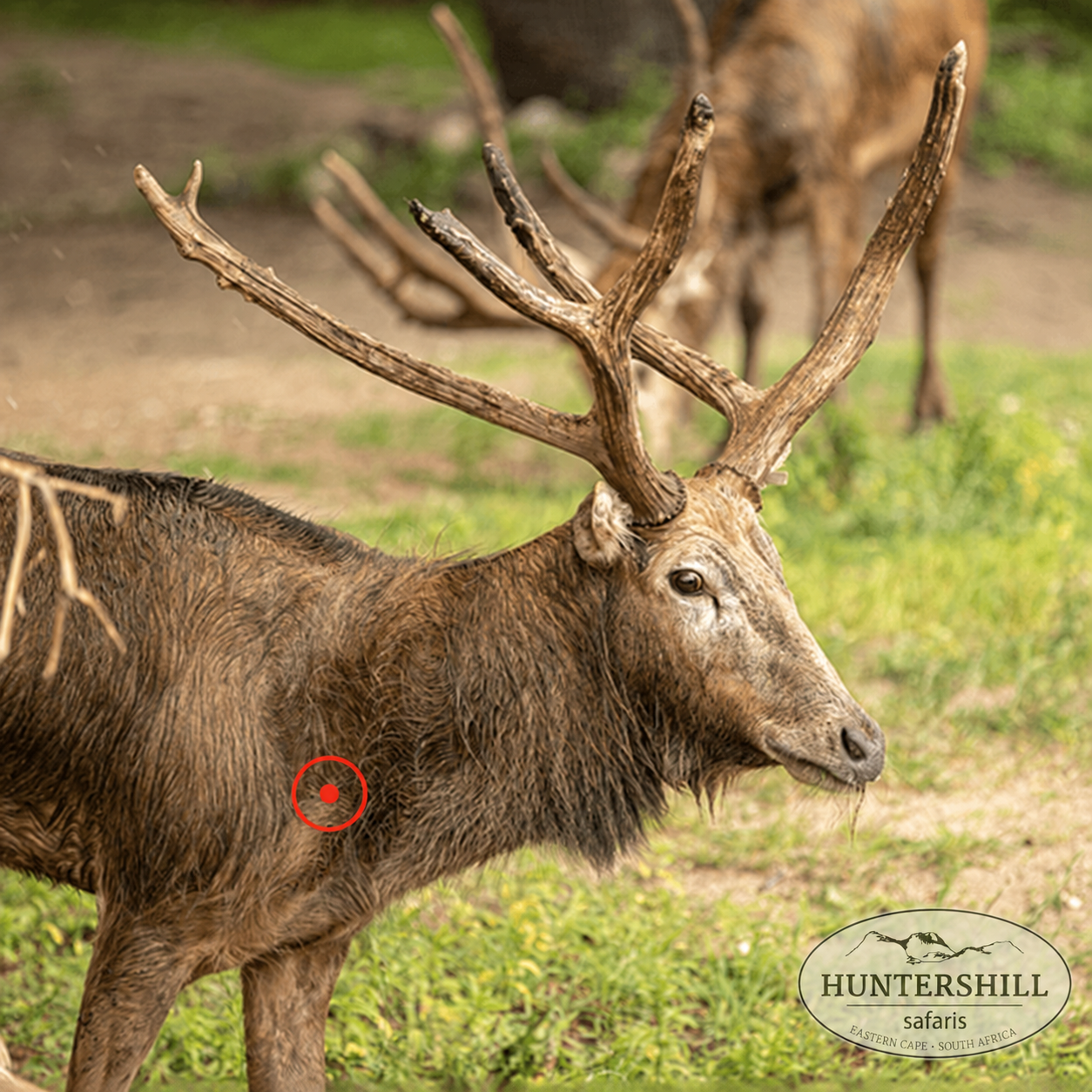
A quartering-toward presentation places the shoulder and upper leg bones in front of the vital area. This reduces the exposed lung target and demands greater penetration. Sharp frontal and rear-facing angles provide a much narrower route to the vital organs.
The long hair around a mature stag’s chest can make its body appear deeper than it is. The front leg and shoulder joint remain the clearest anatomical references. The professional hunter assesses the exact angle and confirms whether the shot is open.
Plan your Père David’s deer hunt in South Africa
Père David’s deer brings something different to an African safari. It is a large deer with strong herd instincts, an unusual connection to water, and antlers found nowhere else in the deer family.
At Huntershill, the hunt takes place within 55,000 acres of Eastern Cape terrain and can be combined with a wider rifle or bowhunting safari. Experienced professional hunters manage the stalk, assess trophy maturity, and remain with you from the first sighting through to the recovery.
Père David’s deer availability depends on the condition of the herd and the presence of a suitable mature stag. Huntershill can confirm current trophy availability, package options, travel details, and the other species that can be added to your safari.
Enquire about hunting Père David’s deer at Huntershill Safaris.
Frequently asked questions about Père David’s deer hunting
Can Père David’s deer be hunted in South Africa?
Yes. Père David’s deer occur in established, managed populations on selected South African hunting properties, including Huntershill Safaris. Hunting is regulated and depends on the availability of a suitable mature animal.
Can Père David’s deer be hunted with a bow or rifle?
Huntershill offers both rifle and bowhunting safaris. The species’ heavy body requires equipment capable of reaching the heart and lungs with sufficient penetration.
Where should a shot be placed on a Père David’s deer?
The heart and lungs lie low in the chest, behind the front shoulder. Broadside and quartering-away positions provide the clearest route into this vital area.
How much does a Père David’s deer weigh?
A mature stag commonly weighs between 300 and 440 pounds, although individual animals can be heavier. Males are considerably larger and heavier through the neck and chest than females.
What is another name for Père David’s deer?
Père David’s deer is also called the milu. Its traditional Chinese description, “four unlikes,” refers to its unusual combination of physical features.
Why is Père David’s deer considered a rare species?
The species became extinct in its native wild range and survived through a small managed population in Europe. Descendants of those animals were later returned to protected reserves in China and established in other managed populations.
Can Père David’s deer be added to a plains-game safari?
Yes. At Huntershill, Père David’s deer can form part of a customized African hunting safari with other available species. The final package depends on trophy availability, hunting method, travel dates, and the hunter’s priorities.